Let’s be honest about something. Back in 2020, a whole lot of us set up a “temporary” home office. A folding table in the guest room. A laptop at the kitchen island. That little desk from the big-box store that you told yourself would work just fine for a few months.
And here we are. Years later. Still at the folding table.
I see it all the time around Huntersville and Cornelius and out toward Mooresville. Somebody calls me about a closet, and while we’re walking the house they wave a hand at a room and say, “Oh, ignore that, that’s just where I work.” And then I look in there and it’s not “just” anything. It’s where they spend forty, fifty hours a week. It’s where they take calls, sign contracts, run a business, do the actual work of their life. And it’s furnished like an afterthought.
Here’s the thing about a room you use full-time: it will show you every single flaw. A desk you sit at twice a week can get away with a lot. A desk you sit at every day, all day? It’s going to punish you for every bad decision. So let’s talk about what actually changes when the home office stops being temporary.
Start with your day, not your square footage
When I sit down with somebody for a consultation, I don’t start with a tape measure. I start with questions. What does a Tuesday look like for you? What do you touch every single day? What do you need twice a year but panic about when you can’t find it?
Because the mistake almost everybody makes is giving all their stuff equal real estate. The stapler you use daily gets the same drawer as the 2019 tax return. The box of extra printer paper takes up prime elbow-level space while your headset lives on the floor.
I think about it in three zones, and this is not fancy, it’s just useful:
Daily stuff goes in the reach zone — arm’s length while you’re seated. You should never have to stand up for something you touch ten times a day.
Weekly stuff goes in the room zone — you can get up for it. That’s fine. Standing up once an hour is good for you anyway. I’m no spring chicken and I’ll take any excuse.
Deep storage goes up high, down low, or behind doors. Archives, backup supplies, the stuff you’d have to think hard about before throwing away.
That’s it. That’s the whole framework. But you’d be amazed how many offices break the second you apply it, because the daily stuff is buried behind the twice-a-year stuff.
Yes, you still have paper. It’s okay.
Everybody tells me their office is paperless. Then I open a drawer.
I’m not judging! I have paper too. Even the most digital job in the world seems to generate a stack — printed contracts, a draft somebody wanted to mark up, the permission slip your kid handed you at 7:15 a.m. that landed on your desk because your desk is where everything lands.
So let’s plan for it instead of pretending.
A real file drawer with full-extension glides makes a bigger difference than people expect. The cheap partial-extension kind means the back third of the drawer is a mystery zone you never reach into. Full extension, hanging file rails, and suddenly filing takes four seconds instead of being a chore you avoid until Saturday.
And give yourself a landing spot. One tray, one slot, one designated place where the daily pile goes. Because the pile is going to exist. If it doesn’t have a home, its home becomes your desk.
If you handle anything sensitive — client files, HR paperwork, financial records — a lock on one drawer is worth every penny. Not because you don’t trust your family. Because it means you stop worrying about it.
Design the wall behind you
This is the one that’s genuinely new, and it cracks me up a little. Your storage is now on camera.
Think about it. If you’re on video calls a few hours a day, that wall behind you is being seen by your boss, your clients, your team, people you’ve never met. It’s the most-viewed wall in your house and nobody plans for it.
So decide early which wall is the camera wall. Then be intentional:
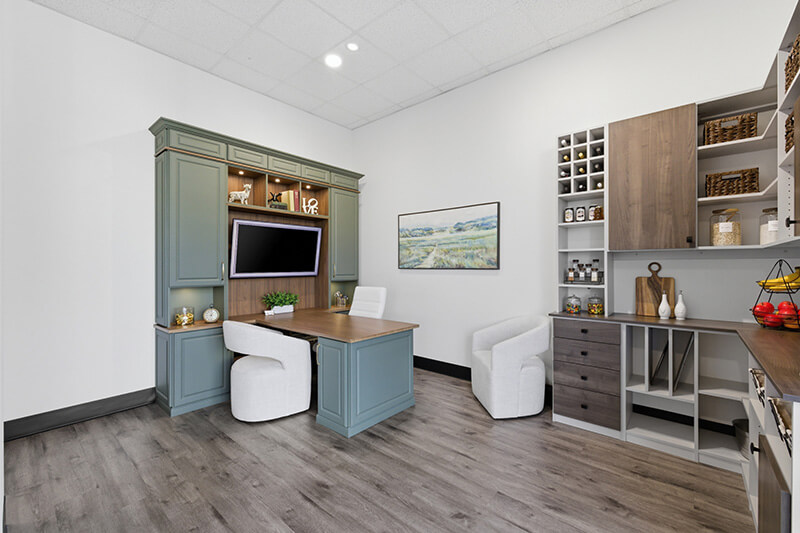
Closed cabinetry behind the desk gives you a clean, calm backdrop and hides absolutely everything. If you like a little warmth on camera, mix in some open shelving — but be honest with yourself about whether you’ll keep it styled. Open shelves are a commitment. Glass fronts are a nice middle ground; you get depth and light without every binder on display.
And lighting. Please, lighting. So many people are lit by one sad lamp aimed at the side of their face. Integrated LED strips in the cabinetry do wonders, and you can control the color temperature so you don’t look like you’re being interrogated.
Hide the tech, hide the cables
Nothing makes a beautiful office look chaotic faster than seventeen cords.
A printer garage is one of those things people don’t think to ask for and then love. It’s a cabinet with a pull-out shelf — the printer slides out when you need it, disappears when you don’t. Same idea for a shredder if you use one.
Then there’s everything else: the router blinking away, the surge protector, the shoebox of dongles and chargers that every household seems to accumulate. Grommets and wire channels take about five minutes to plan and save you daily annoyance. A charging drawer with a power strip inside it means phones, headsets, and backup batteries all live in one place and none of it is on your desk.
You don’t know you need it until you have it, and then you genuinely cannot imagine going back.
Storage that handles real volume
Somebody working full-time buys paper by the case. Toner in multiples. If you sell anything, you’ve got mailers and boxes and tape and a label printer.
Deep lower cabinets are your friend here — heavy, bulky supplies belong down low where the weight makes sense and you’re not lifting a case of paper over your head.
And adjustable shelving, always. This is the thing I’ll die on a hill about. Fixed shelves are a guess somebody made in a factory about what your stuff looks like. Your stuff doesn’t look like that. Adjustable shelving means you set the spacing to your binders, your bins, your equipment, and then reset it in two years when your work changes. Because it will.
If you ship product, carve out a packing station — even eighteen inches of dedicated counter with the tape and mailers underneath. It turns a twenty-minute scramble into a five-minute task.
When the office has to share a room
Not everybody gets a whole room. Around here I’d say most people don’t. The office is in the guest room, the bonus room, the formal dining room nobody’s eaten in since the Clinton administration, or a corner of the primary bedroom.
That’s completely workable. It just needs a plan.
The closet office. Take a five-foot reach-in you’re barely using, pull out the wire shelf, and build in a desk surface with shelving above and drawers below. Add doors and at 5 p.m. you close them and the workday is over. For anybody who struggles to stop working — and if you work from home, that’s you — being able to physically shut the door on it is worth more than the storage.
The guest room. Cabinetry with doors means when your mother-in-law shows up, the office disappears and it’s a bedroom again. Nobody’s sleeping next to your project files.
The bonus room. Built-ins are great for defining the work zone in a big open space. A run of cabinetry acts like a soft wall — it gives the desk a sense of “this is the office” without any actual construction.
Two people, one office
This is more and more common, and I love it, and it needs to be designed carefully or somebody’s getting divorced.
Give each person their own vertical column of storage. Not shared shelves — separate territory, top to bottom. It sounds petty. It is not petty. It’s the difference between “where’s my charger” being a five-second question and a five-minute argument.
Think about desk placement so you’re not both on camera in each other’s shot, and so two people talking at once isn’t unbearable. And if one of you handles confidential work, that lock we talked about earlier just got a lot more important.
The part that makes it stick
Here’s the honest truth: any organized office falls apart in about three weeks if the design doesn’t match how you actually behave. I’ve seen gorgeous rooms go sideways because there was no home for the one thing the person touches constantly.
So the test is simple. Can you clear your desk completely in sixty seconds at the end of the day? If yes, you’ve got a system. If no, something on that desk doesn’t have a home yet, and that’s the piece to fix.
And label the deep storage. I don’t care how good your memory is. Future you, standing on a stool, will not remember what’s in the top left bin.
Why built-in wins over bought
I’ll keep this short because I hate a sales pitch.
Freestanding furniture wastes space. Three inches here, six inches there, and it stops eighteen inches shy of your ceiling — which in a lot of these Lake Norman bonus rooms means you’re throwing away several feet of usable vertical storage. Custom goes floor to ceiling, wraps around the window, works around the knee wall and the HVAC return instead of pretending they aren’t there. And it’s built to be sat at every day, not assembled with an Allen wrench.
That’s really the whole argument.
The payoff
The reason we do this job is the moment somebody walks into their finished space and just kind of exhales. All that visual clutter — the stacks, the cords, the boxes in the corner — it wears on you in a way you don’t notice until it’s gone. And when it’s gone, you get your focus back. You get a room you’re not embarrassed to have on camera. You get to close the day out and actually be done.
If this room is where you spend your working life, it deserves to be designed like a workspace, not decorated like a spare room.
If you want to talk it through, we do a free in-home consultation — no obligation, no pressure, none of that. We’ll measure, ask you a bunch of nosy questions about your Tuesdays, and put together a 3D design so you can see it before you spend a dollar. We work all around Huntersville, Charlotte, Cornelius, Davidson, Mooresville, Fort Mill, and everywhere in between.